
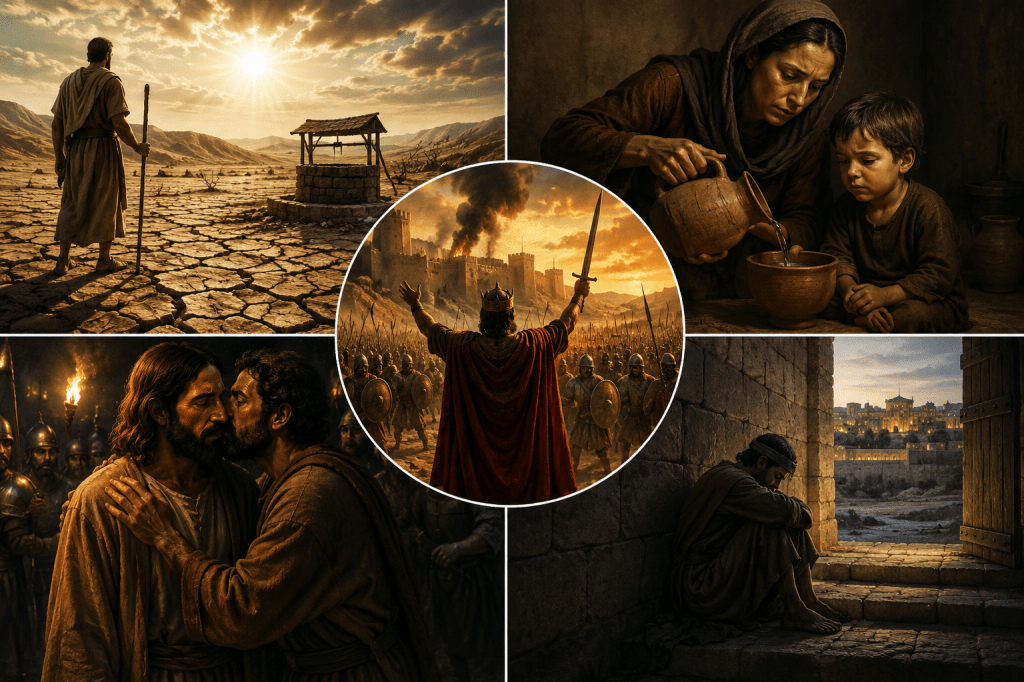
The Bible Was Never Meant to Be Admired. It Was Meant to Be Lived.
“These things happened to them as examples and were written down as warnings and instruction for us …” – 1 Corinthians 10:11
There is a subtle danger that confronts every generation of believers. It is not the danger of rejecting the Bible, but of reducing it to a collection of remarkable stories that belong to another time. We admire Noah for building an ark, Abraham for leaving his homeland, Moses for confronting Pharaoh, David for facing Goliath, and the Apostles for turning the world upside down. We celebrate their faith, quote their testimonies, and teach their stories to our children. Yet when our own lives begin to resemble theirs, our response is often very different.
When drought visits our finances, we panic. When famine reaches our homes, we cling tighter to what little we have. When betrayal wounds our hearts, we seek revenge. When battles surround us, we trust our own strength before seeking the Lord. We admire the faith of biblical men and women while quietly resisting the kind of obedience that made their testimonies possible.
The Scriptures were never given merely to preserve history. They reveal the character of God and the unchanging principles of His Kingdom. The Bible does not simply tell us what God once did; it shows us how He continues to work. Every account is an invitation to know His heart, trust His voice, and discover that His ways remain the same across every generation.
The people change. The cultures change. The circumstances change. But Heaven’s way never changes.
Isaac’s drought may not look like ours. The widow’s famine may differ from our seasons of lack. Jehoshaphat’s battlefield may not resemble the battles we fight today. Yet behind every story stands the same God, calling His people to trust Him beyond what human reasoning can understand.
These stories were not written so we would applaud yesterday’s miracles. They were written so that, when similar moments arrive in our own lives, we would know how Heaven responds.
Drought – When God’s Voice Contradicts Human Logic
Drought is one of the most unsettling experiences in life. Whether it appears as financial hardship, emotional exhaustion, spiritual dryness, or the collapse of carefully made plans, drought exposes how quickly human security can disappear. Our natural instinct is to escape. We search for greener pastures, better opportunities, and quicker solutions. Logic tells us that survival depends upon finding a place where conditions appear more favourable.
Isaac found himself in precisely such a season.
The land was gripped by famine and drought. Every practical calculation suggested that Egypt, known for its resources, would be the wiser destination. Yet before Isaac could act upon what seemed obvious, God spoke: “Do not go down to Egypt. Stay in the land I tell you about.”
That instruction made little sense from a human perspective. Remaining meant uncertainty. Remaining meant enduring difficult circumstances. Remaining meant trusting a promise that could not yet be seen.
Faith often begins where logic reaches its limit.
Isaac chose obedience over observation. He planted in a land that appeared incapable of producing anything. He trusted God’s promise above what his eyes could see. Scripture tells us that in that very year he reaped a hundredfold because the Lord blessed him.
Notice that God did not remove the drought before blessing Isaac. The drought remained, but so did the Lord.
This is one of the great lessons of the Kingdom. God’s provision is not ultimately controlled by the condition of the environment but by His covenant faithfulness. The same sun that scorched the land could not prevent the blessing that flowed from God’s hand.
How often do we allow circumstances to become louder than God’s voice? We wait for the situation to improve before obeying, when God may be inviting us to obey so that we can witness His faithfulness within the difficulty.
Perhaps your drought today is not a lack of rain but a season where prayers seem unanswered, opportunities seem delayed, and hope feels fragile.
Heaven’s invitation remains the same: trust the One who speaks more than the landscape you see.
The drought was real. But so was the voice of God. Isaac chose the voice over the landscape.
Scripture: Genesis 26:1–14
Famine – When Obedience Unlocks Provision
Few circumstances test faith more deeply than lack. Lack has a way of narrowing our vision until survival becomes our highest priority. We become consumed with protecting what remains, fearing that every act of generosity will leave us with even less.
The widow of Zarephath understood that feeling all too well.
She had reached the end of her resources. Her cupboard held only enough flour and oil for one final meal. Her plan was painfully simple: prepare the last portion of food for herself and her son, eat together, and then wait for death.
From every human perspective, her conclusion was reasonable.
Then the prophet Elijah arrived with an astonishing request: “First make a small loaf for me …”
What an impossible command!
God’s instruction was not asking from her abundance but from her emptiness.
Everything within human reasoning would argue against such obedience. Yet faith has never been measured by how we respond when we have plenty. Faith is revealed in what we do when obedience appears costly.
The widow chose to trust the word of the Lord spoken through His prophet. She gave before she received. She surrendered before she saw evidence that God would provide. And Heaven responded. The flour did not run out. The oil did not fail. Day after day, the God who created the heavens quietly sustained one ordinary household through extraordinary means.
Provision did not arrive because the famine ended. It arrived because faith welcomed God’s promise into the middle of the famine.
How often do we postpone obedience until we feel secure? We tell ourselves that we will trust God once our circumstances improve. Yet throughout Scripture, God repeatedly invites His people to trust Him first, allowing His faithfulness to become the foundation upon which their security rests.
The widow’s story reminds us that Heaven’s economy does not operate according to earthly scarcity. God is not limited by the emptiness of our jars or the size of our bank accounts. He remains the God who provides for those who place His word above visible resources.
Provision did not begin in the jar. It began in obedience.
Scripture: 1 Kings 17:8–16
War – When Worship Becomes the Weapon
Battles have a unique ability to expose the condition of our hearts.
When conflict arrives, our instinct is to calculate our own strength. We count our resources, measure our weaknesses, and search for strategies that promise success. Fear persuades us that victory depends entirely upon our own ability.King Jehoshaphat faced an overwhelming reality.
A vast coalition of enemy armies marched toward Judah. The situation was beyond human control. No military strategy could guarantee success. Every report pointed toward disaster. Yet Jehoshaphat’s first response was not to strengthen his army. He sought the Lord. As the nation gathered in prayer, God spoke through His prophet with words that have comforted believers for generations: “Do not be afraid or discouraged because of this vast army. For the battle is not yours, but God’s.”
The next instruction was even more astonishing.
Instead of placing elite soldiers at the front, Jehoshaphat appointed singers.
Imagine the scene. The enemy advanced with weapons drawn, while the people of God marched forward singing of the Lord’s holiness and steadfast love.
It was not denial. It was declaration.
Their worship proclaimed that God’s character was more trustworthy than their circumstances were frightening. And as praise rose from God’s people, Heaven moved. Confusion entered the enemy’s camp, alliances collapsed, and Judah witnessed a victory they could never have produced through their own strength.
Many of us are fighting battles today that cannot be won by cleverness alone. Anxiety, broken relationships, impossible decisions, spiritual warfare, and unseen struggles often leave us feeling outnumbered.
Jehoshaphat’s story does not teach us to ignore reality. It teaches us to acknowledge a greater reality that the Lord remains sovereign over every battle His children face.
Worship is not an escape from conflict. It is an act of confidence in the God who reigns above it. Before Heaven won the battle, Judah learned to sing.
Scripture: 2 Chronicles 20:1–30
Betrayal – What Was Meant to Destroy, Becomes the Path to Purpose
Few wounds cut as deeply as betrayal.
Pain inflicted by strangers can be difficult, but pain inflicted by those we have loved, trusted, or welcomed into our lives often leaves scars that seem impossible to heal. Betrayal raises questions that linger long after the moment has passed. Why did this happen? Could I have prevented it? How can something so painful ever serve a purpose?
The life of Jesus answers those questions in a way that no human philosophy ever could.
The Son of God was not betrayed by an enemy from a distance but by one of His own disciples. Judas had walked with Him, listened to His teachings, witnessed His miracles, and shared meals at His table. Yet it was that very disciple who exchanged his Master for thirty pieces of silver and identified Him with a kiss.
To human eyes, it appeared that evil had finally won.
The betrayal led to false accusations, an unlawful trial, unbearable suffering, and ultimately the Cross. Everything about those events suggested defeat. Yet Heaven was writing a completely different story.
The Cross was never the triumph of betrayal. It was the triumph of redemption.
What Judas intended as an act of destruction became the very pathway through which God reconciled humanity to Himself. The greatest act of human wickedness became the greatest demonstration of divine love.
This does not mean betrayal is good. Scripture never celebrates betrayal. It grieves it. But it also reveals a God whose sovereignty is so great that even the darkest actions of mankind cannot cancel His eternal purposes.
Many believers spend years asking God to remove the consequences of betrayal, when perhaps He desires to reveal His glory through the very place where they were wounded.
The Cross reminds us that God never wastes pain surrendered to Him.Sometimes the very road that breaks our hearts becomes the road that fulfils our calling.
What was meant to destroy Jesus became the doorway through which millions would receive life. What people place in God’s hands can never remain merely a tragedy.
Scripture: Matthew 26:47–50; John 19:16–30
Forgotten – Heaven Never Loses Sight of the Faithful
One of the quietest forms of suffering is being forgotten.
Not abandoned. Not persecuted. Simply overlooked!
Many faithful people know this feeling well. They continue serving, loving, praying, and remaining loyal while watching others receive recognition, promotion, and honour. It can seem as though faithfulness goes unnoticed.
Mordecai understood this experience. He faithfully served at the king’s gate. When he uncovered a conspiracy to assassinate the king, he reported it, and the king’s life was spared. His act of loyalty was officially recorded.
Then… Nothing happened!
No celebration. No reward. No recognition.
The pages of history seemed to move on while Mordecai remained at the gate, unnoticed by those in power.
To make matters worse, Haman rose to prominence and demanded honour that he neither deserved nor reflected. Mordecai, refusing to compromise his devotion to God, became the target of hatred and injustice.
From every human perspective, it appeared that righteousness had been forgotten while pride prospered. But Heaven had not forgotten.
One sleepless night changed everything.
The king ordered the royal records to be read aloud, and there, hidden among countless records, was the forgotten act of Mordecai’s faithfulness.
God’s timing unfolded with breathtaking precision.
The man marked for humiliation was clothed in royal garments. The one who sought honour was humbled. The God who sees in secret displayed His justice before an entire nation.
How many believers quietly wonder whether their faithfulness matters?Perhaps no one notices your sacrifices. Perhaps your integrity has cost you opportunities. Perhaps your obedience has gone unrecognised.
Mordecai’s story reminds us that Heaven keeps better records than earth ever could. God’s delays are never signs of forgetfulness. Often they are preparations for a testimony that will reveal not only His justice but also His perfect timing. People may overlook your faithfulness. God never does. Heaven never forgets those who remain faithful while no one is watching.
Scripture: Esther 2:21–23; Esther 6:1–11
to be continued …
